Production / IQ Scheduling Optimiser
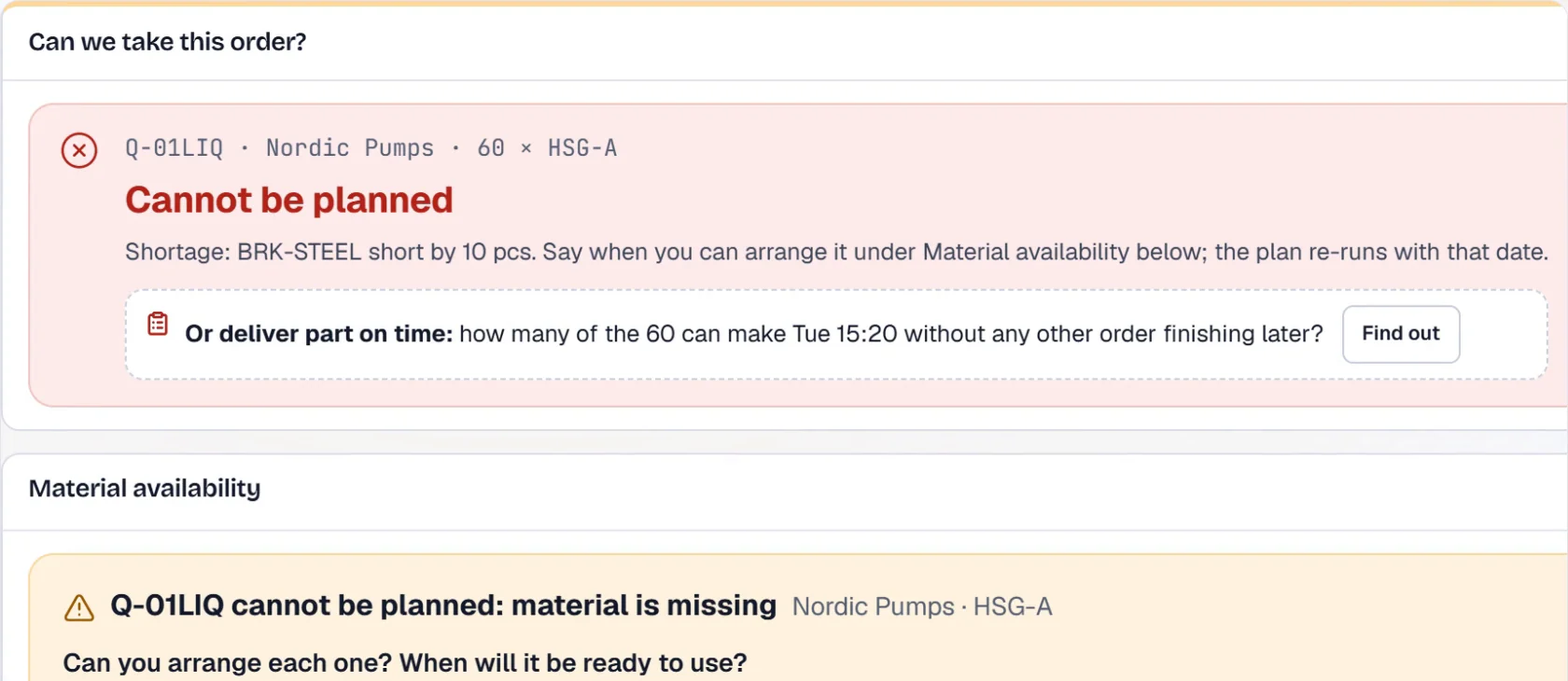
An urgent order arrives. Can we take it without delaying any other customer? Test it in a scenario, see what is missing, compare the options and make the call.
The problem
A planned week rarely survives Monday. A customer asks for 60 housings by Tuesday afternoon, purchasing says the steel will be late, a machine stops. Each time the real question is the same: what happens to every other order if we say yes? In a spreadsheet that takes hours and still ends in a guess.
What it does
- Test an enquiryA new order goes into a scenario that never touches the order book, with a choice of how much the published plan may move.
- Check every materialEach missing material is listed with the time it is needed; the planner enters when each can really arrive.
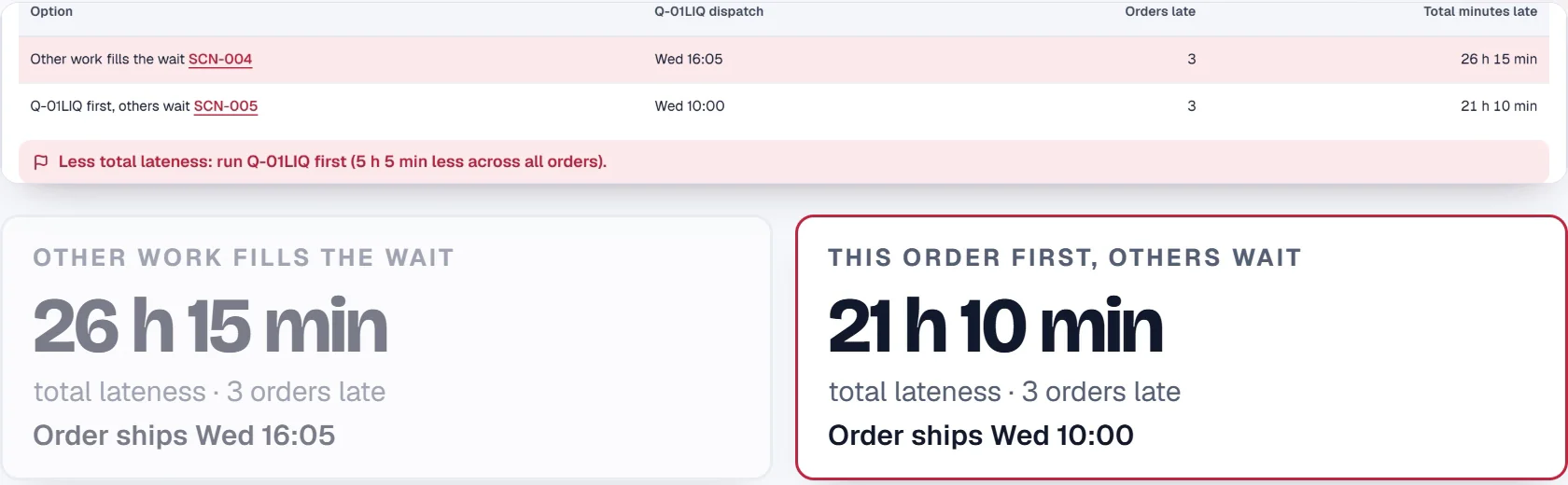
- Wait or fill the gapIf an arrival is late, two schedules are solved: hold the machine for the order, or let other work use the wait.
- Split the deliveryFinds the largest quantity that still makes the date without any other order finishing later.
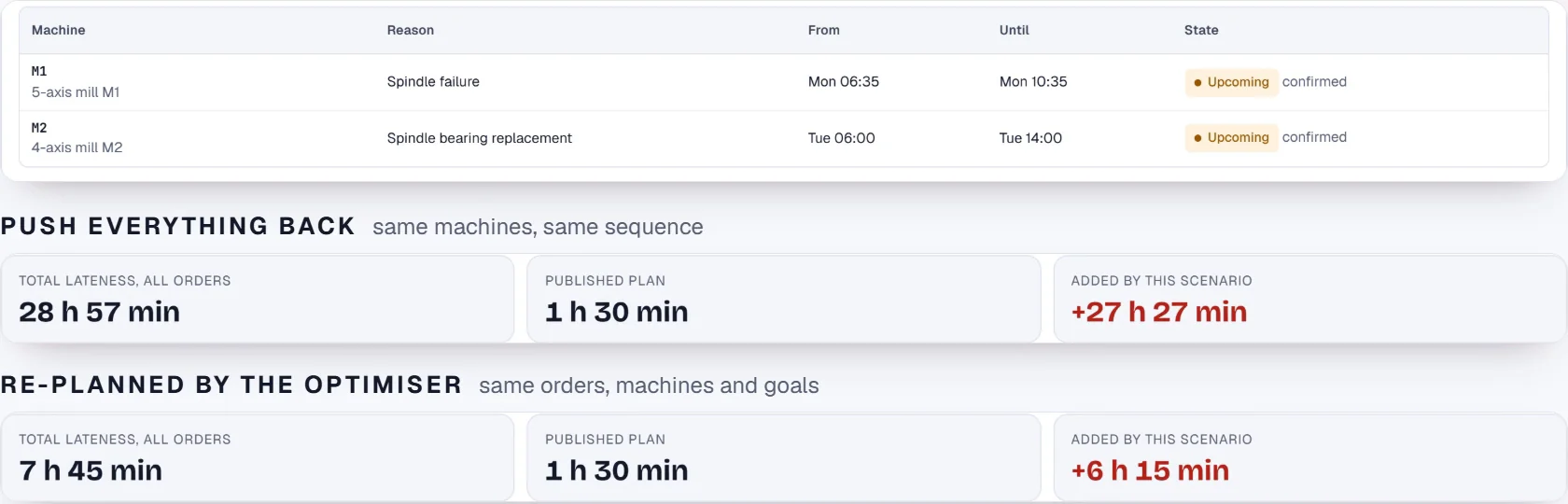
- Recover from a breakdownRe-plans around downtime and shows which orders move, by how much, against the published plan.
- Write the planA written plan per machine, with each idle gap explained and changeover times included.


How it decides
The optimiser (Google OR-Tools CP-SAT) solves the goals in that order. Each result is locked before the next goal is optimised, so a later goal can never trade away an earlier one. The planner can reorder or remove goals, weight or protect individual orders and cap lateness. An independent validator re-checks every schedule before it is shown.
Trade-offs it puts in front of the planner
| Situation | Option A | Option B |
|---|---|---|
| Steel arrives 10 h 40 min late | Other work fills the wait: 26 h 15 min total lateness, 3 orders late, ships Wed 16:05 | This order first: 21 h 10 min, 3 orders late, ships Wed 10:00 |
| M1 stops for 4 hours | Push everything back: +27 h 27 min total lateness, 8 orders late | Re-plan: +6 h 15 min, 3 orders late (same orders, machines, goals) |
Running the order first cuts total lateness by 5 h 05 min with no extra late orders, and the customer gets Wednesday 10:00. Every figure here is read from the app, which shows each scenario's total lateness against the published plan. The software calculates the trade-off; the planner makes the call.
Built with
283 backend and 131 frontend automated tests. Scenarios are frozen snapshots of the plant, so nothing tested in them can be published by accident.
The video and all figures come from a demo plant with synthetic orders, materials and machines. No employer data is shown.
Planning should turn complexity into action.
Open to Production Planner, Materials Planner, Production Controller and Supply Chain Planning roles in the UK.